
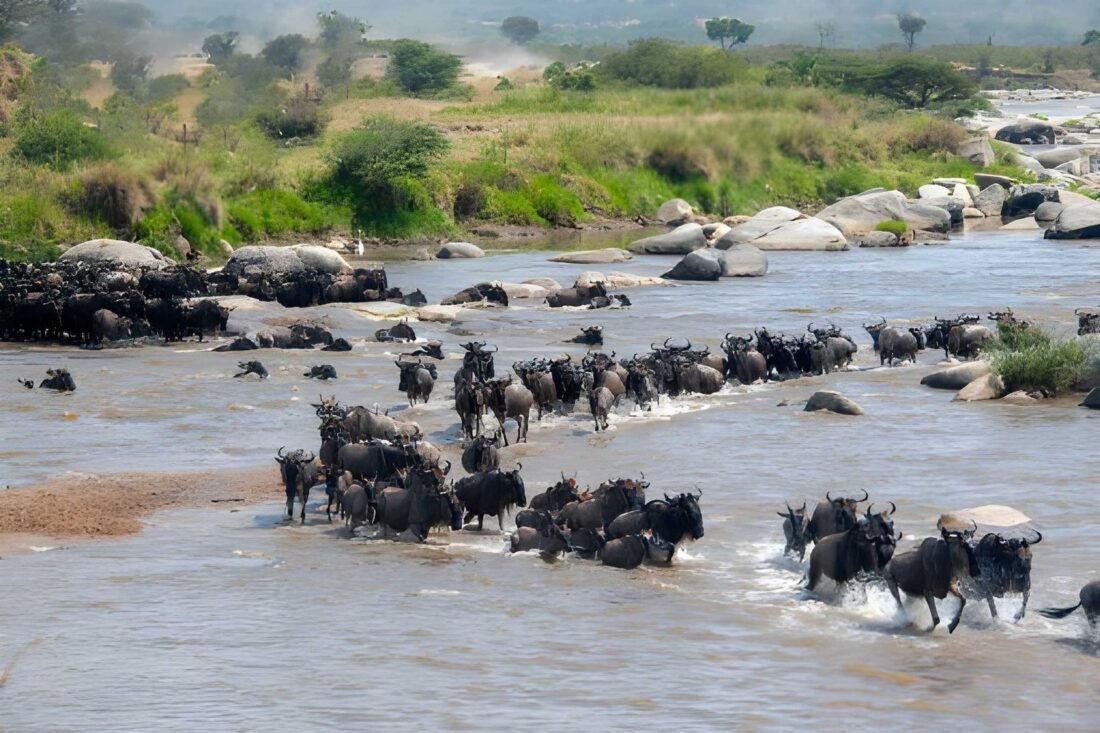
The Great Migration in Tanzania is one of the most extraordinary wildlife spectacles on Earth, attracting travelers from around the world who dream of witnessing millions of animals moving across the Serengeti ecosystem.
Some travel experiences are impressive.
Others are unforgettable.
And then there are experiences so extraordinary that they permanently change the way you see the natural world.
The Great Migration belongs to that final category.
Imagine standing in the middle of the Serengeti.
The horizon seems endless.
The air is still.
Then, in the distance, you notice movement.
At first, it looks like a dark line stretching across the plains.
Then the line grows.
And grows.
Until you realize what you’re witnessing.
Not hundreds.
Not thousands.
But hundreds of thousands of animals moving together across the African wilderness.
The sound arrives before the full spectacle becomes visible.
Hooves striking the earth.
Dust rising into the sky.
The distant calls of wildebeest echoing across the plains.
It is one of the few wildlife events on Earth that genuinely exceeds expectations.
Photographs cannot fully capture it.
Videos cannot fully explain it.
The Great Migration must be experienced to be understood.
For many travelers, witnessing this phenomenon becomes the primary reason for visiting Tanzania.
And once they’ve seen it, they rarely forget it.
This guide explains everything you need to know about the Great Migration in Tanzania, including how it works, where it happens, when to visit, and how to plan the safari experience of a lifetime.
What Is the Great Migration?
The Great Migration is the largest overland animal migration on Earth.
Every year, millions of animals move through the Serengeti-Mara ecosystem in search of fresh grazing and water.
Unlike many people assume, the migration is not a single event.
It is a continuous cycle.
A never-ending journey driven by rainfall, grass growth, survival, and instinct.
The migration primarily involves:
- More than 1.5 million wildebeest
- Hundreds of thousands of zebras
- Hundreds of thousands of gazelles
Together, they move across an enormous ecosystem spanning northern Tanzania and southern Kenya.
The migration never truly stops.
Animals are always moving.
Always searching.
Always responding to environmental conditions.
This is one reason the Great Migration remains so fascinating.
No two years are identical.
No two safaris are identical.
Every season tells a different story.
Why Does the Great Migration Happen?
The answer is surprisingly simple.
Food.
Water.
Survival.
The animals are following rainfall patterns.
When rain falls, grass grows.
When grass grows, grazing animals move toward it.
As conditions change, the herds continue moving.
This pattern has existed for thousands of years.
Long before roads.
Long before tourism.
Long before modern conservation.
The migration follows ancient routes shaped by nature itself.
No leader directs the movement.
No animal controls the herd.
Instead, millions of individual decisions combine into one of the most remarkable wildlife spectacles on Earth.
Why the Great Migration Is Unlike Anything Else
Many wildlife destinations offer excellent game viewing.
Many parks have lions.
Many parks have elephants.
Some even have large herds of animals.
The Great Migration is different because of its scale.
The numbers are difficult to comprehend until you see them in person.
Imagine watching a herd of wildebeest.
Then imagine that herd extending beyond the horizon.
Then imagine another herd behind it.
And another.
And another.
The migration creates a sense of abundance that feels almost prehistoric.
It reminds visitors what the natural world looked like before large-scale human development transformed much of the planet.
For many travelers, this feeling becomes even more memorable than the famous river crossings themselves.
The Serengeti: The Heart of the Migration
Although the migration enters Kenya during part of the year, Tanzania remains the true heart of the Great Migration.
Most of the annual cycle takes place inside the Serengeti ecosystem.
This is why understanding the park itself is so important.
If you’re unfamiliar with the region, our Serengeti National Park Safari Guide explains the landscapes, wildlife, and safari opportunities that make the Serengeti one of the world’s greatest wildlife destinations.
Without the Serengeti, the migration could not exist in its current form.
The vast grasslands provide the grazing resources needed to support millions of animals.
The ecosystem’s size allows herds to move naturally according to seasonal conditions.
It is one of the last places on Earth where wildlife still operates on this scale.
The Animals of the Great Migration
While wildebeest receive most of the attention, they are far from the only participants.
The migration ecosystem includes a remarkable variety of species.
Wildebeest
The stars of the show.
Their numbers dominate the migration.
They are the animals most travelers associate with the event.
Thousands become millions.
Millions become moving landscapes.
Their determination drives the entire cycle.
Zebras
Often overlooked, zebras play an important role.
Unlike wildebeest, zebras prefer longer grasses.
This difference helps reduce competition between species.
Many migration photographs include dramatic zebra herds moving alongside wildebeest.
Gazelles
Gazelles complete the migration trio.
They move with the larger herds while taking advantage of fresh grazing opportunities.
Though smaller and less obvious, they contribute significantly to the spectacle.
The Predators Follow Too
Where prey gathers, predators follow.
The Great Migration is not only a story about herbivores.
It is also a story about survival.
Throughout the year, predators take advantage of the enormous concentration of animals.
These include:
- Lions
- Leopards
- Cheetahs
- Hyenas
- Crocodiles
For predators, the migration creates extraordinary hunting opportunities.
For safari travelers, it creates some of Africa’s most dramatic wildlife encounters.
Many visitors arrive hoping to see river crossings.
They leave talking about lion hunts.
This is one reason Tanzania remains one of the world’s best safari destinations.
If you’re interested in the broader wildlife story, our Faune de la Tanzanie : les cinq grands et au-delà guide explores the incredible diversity found throughout the country.
The Great Migration Is More Than River Crossings
This is perhaps the biggest misconception surrounding the migration.
Ask most travelers what they know about the Great Migration and they’ll mention one thing:
River crossings.
The images are famous.
Thousands of wildebeest leap into crocodile-filled rivers.
Chaos erupts.
Dust fills the air.
The scenes are dramatic.
But they represent only a small part of the annual cycle.
The migration is happening every month of the year.
Sometimes the most rewarding experiences occur far from the rivers.
A newborn wildebeest taking its first steps.
A cheetah stalking prey across open plains.
Thousands of animals spread across green grasslands after seasonal rains.
These moments rarely appear on social media.
Yet they often become the memories travelers treasure most.
Understanding the Migration Cycle
The easiest way to understand the migration is to think of it as a giant circle.
The animals are constantly moving through different regions of the ecosystem.
Rainfall patterns influence the journey.
Fresh grass determines direction.
Predators follow.
Life continues.
Death occurs.
New generations are born.
Then the cycle begins again.
This endless movement is what makes the Great Migration one of nature’s greatest stories.
Unlike a sporting event or scheduled attraction, the migration is alive.
Dynamic.
Unpredictable.
And that unpredictability is precisely what makes it so extraordinary.
Why People Travel Across the World to Witness It
Most travelers don’t come to Tanzania simply to see animals.
They come for something deeper.
A sense of connection.
Perspective.
Wonder.
The Great Migration provides all three.
It reminds us that nature still possesses the power to operate on a scale beyond human control.
No fences guide the herds.
No schedules determine their movements.
The migration continues because it always has.
And standing in the middle of that story is an experience few people ever forget.
For many visitors, it becomes the highlight of an entire lifetime of travel.
The Great Migration Month by Month
One of the most common questions travelers ask is:
“When is the best time to see the Great Migration?”
The answer depends entirely on what you want to experience.
Do you want to see newborn animals taking their first steps?
Do you dream of witnessing dramatic river crossings?
Are you hoping for fewer crowds and lower prices?
The migration changes throughout the year, and each season offers something unique.
Understanding the annual cycle is one of the most important parts of planning a successful safari.
If you’re comparing seasons across the country, our Best Time to Visit Tanzania for Safari, Kilimanjaro & Beaches guide provides a broader overview of Tanzania’s travel calendar.
January: The Southern Plains Come Alive
January is one of the most beautiful months in the migration cycle.
The herds gather across the southern Serengeti and Ndutu region.
Fresh grasses created by seasonal rains attract enormous concentrations of wildebeest, zebras, and gazelles.
Wildlife viewing is exceptional.
Predators are never far away.
The landscape is green.
The atmosphere feels alive with anticipation.
This is nature preparing for one of its most important annual events.
February: Calving Season Begins
For many safari experts, February is the most underrated month of the entire migration.
This is calving season.
Hundreds of thousands of wildebeest calves are born within a remarkably short period.
The numbers are astonishing.
Thousands of newborn animals appear across the plains every day.
Many calves stand and walk within minutes of birth.
The instinct to survive begins immediately.
Unfortunately, predators know this too.
Lions.
Cheetahs.
Hyenas.
Leopards.
All take advantage of the abundance of vulnerable prey.
The result is some of the most dramatic wildlife viewing found anywhere in Africa.
March: Life and Survival
The southern Serengeti remains the center of migration activity.
Large herds continue grazing.
Young calves become stronger.
Predator encounters remain frequent.
March offers a fascinating balance between beauty and survival.
The landscape is still lush.
Wildlife concentrations remain extraordinary.
Many travelers who visit during this period are surprised by how active the ecosystem feels.
April: The Journey Begins
As rainfall patterns change, the herds begin moving.
The migration starts shifting northwest.
Animals follow fresh grazing opportunities.
Long columns of wildebeest stretch across the plains.
The movement becomes more obvious.
The migration is no longer concentrated in one area.
It is becoming a journey once again.
Because visitor numbers are lower, April can also offer excellent value.
Travelers interested in quieter safaris should consider our Serengeti Low Season Green Season Safari Guide, which explains why many experienced visitors deliberately travel during these months.
May: Endless Lines of Wildlife
May is one of the most visually spectacular months of the migration.
The herds form enormous columns as they continue moving northwest.
Photographers often love this period.
The scale of the migration becomes easier to appreciate.
Thousands of animals stretch across the landscape.
Dust rises behind them.
Predators remain close.
The entire ecosystem feels in motion.
Unlike river crossing season, the focus here is movement itself.
And that movement is breathtaking.
June: Approaching the Western Corridor
June marks a transition period.
Dry-season conditions begin developing.
The migration continues toward the western regions of the Serengeti.
Wildlife viewing remains excellent.
The herds become increasingly concentrated.
Excitement builds because one of the migration’s most famous phases is approaching.
Grumeti River Crossings
Before the Mara River receives international attention, another crossing takes place.
The Grumeti River.
Located in the western Serengeti, this river presents one of the first major obstacles faced by migrating herds.
Crossings here are often less crowded than those in the north.
They can also be highly dramatic.
Large crocodiles wait beneath the surface.
Animals hesitate along the riverbanks.
Then suddenly, the crossing begins.
The chaos lasts only moments.
But those moments can be unforgettable.
July: The Northern Movement Accelerates
July is one of the most popular safari months in Tanzania.
The migration continues moving north.
Large herds gather throughout northern regions of the Serengeti.
Predator activity remains strong.
Visitor numbers increase significantly.
This is when many travelers arrive hoping to witness river crossings.
However, patience is essential.
Nature does not follow schedules.
Crossings occur when conditions are right.
Not when tourists arrive.
August: Mara River Crossing Season
For many people, this is the month they have been waiting for.
The Mara River crossings are among the most dramatic wildlife events on Earth.
Thousands of wildebeest gather along steep riverbanks.
They hesitate.
Wait.
Move forward.
Retreat.
Then, without warning, one animal jumps.
Others follow.
Within seconds, hundreds may enter the water.
The scene becomes chaotic.
Animals struggle against strong currents.
Crocodiles strike.
Dust fills the air.
The crossing may last minutes.
The memory can last a lifetime.
September: Peak Migration Action
September continues offering excellent migration viewing opportunities.
Many herds remain in northern areas.
River crossings still occur.
Predator sightings remain exceptional.
Weather conditions are generally favorable.
For travelers seeking a combination of migration activity and reliable safari conditions, September is often considered one of the strongest months of the year.
October: The Final Northern Chapter
By October, some herds begin preparing for the journey south.
Migration activity remains impressive.
Wildlife viewing remains outstanding.
Yet subtle changes begin appearing throughout the ecosystem.
The cycle is preparing for its next phase.
Once again, nature moves according to rainfall patterns.
Not according to the calendar.
November: The Return Journey
Seasonal rains begin influencing movement.
The herds start shifting southward.
The migration enters a less predictable stage.
Animals spread across broader areas.
Visitor numbers decline.
Those who travel during November often enjoy a quieter experience.
The migration is still happening.
It simply looks different from the dramatic river-crossing scenes many people expect.
December: Back to the Southern Serengeti
By December, many herds have returned toward the southern plains.
The cycle approaches its starting point.
Fresh grazing opportunities emerge.
Calving season draws closer.
And the migration prepares to begin another remarkable year.
The story never truly ends.
It simply starts again.
The Best Places to See the Great Migration
One reason many travelers miss the migration is simple:
They visit the wrong area at the wrong time.
The Serengeti is enormous.
Knowing where to go is just as important as knowing when to go.
Southern Serengeti
Best for:
- Calving season
- Newborn wildlife
- Predator activity
- January to March
Western Corridor
Best for:
- Grumeti River crossings
- Large moving herds
- June and early July
Northern Serengeti
Best for:
- Mara River crossings
- Peak migration drama
- July to October
Central Serengeti
Best for:
- Year-round wildlife
- Resident predators
- Flexible safari itineraries
Travelers planning their first migration safari should also read our Tanzania Safari Guide for First Timers, which explains how safari logistics, expectations, and wildlife viewing work in practice.
What Most Travelers Get Wrong About the Migration
Many visitors assume the migration is a single event.
It isn’t.
Others assume river crossings happen every day.
They don’t.
Some travelers believe they must visit during August.
That isn’t true either.
The Great Migration is a year-round phenomenon.
Every month offers something different.
The secret is matching your travel dates with the experience you want most.
And that is where careful planning makes all the difference.
What Is the Best Time to See the Great Migration?
There is no single “best” month.
There is only the best month for the experience you want.
This is one of the biggest misconceptions surrounding the migration.
Many travelers assume that everyone should visit during river crossing season.
That isn’t necessarily true.
For some visitors, calving season is even more rewarding.
For others, fewer crowds matter more than dramatic crossings.
The key is understanding your priorities.
Best for River Crossings
July to October
Ideal for travelers who want:
- Mara River crossings
- Dramatic wildlife encounters
- Peak migration activity
- Classic migration photography
This is the most famous migration period.
It is also one of the busiest.
Best for Calving Season
January to March
Ideal for travelers who want:
- Newborn animals
- Predator action
- Green landscapes
- Fewer crowds than peak season
Many experienced safari guides consider this period one of the most exciting phases of the migration cycle.
Best for Photography
January to March and May to June
These periods often provide:
- Beautiful light
- Green scenery
- Lower vehicle density
- Exceptional wildlife behavior
Photographers frequently discover that the best images happen away from the busiest tourist months.
Best for Value
April, May, and November
These months often offer:
- Lower accommodation rates
- Better availability
- Fewer safari vehicles
- Excellent wildlife viewing
Travelers focused on maximizing value should understand both seasonal pricing and safari budgeting before booking.
How Much Does a Great Migration Safari Cost?
The migration is one of Africa’s most sought-after wildlife experiences.
As a result, costs vary significantly depending on:
- Travel season
- Accommodation style
- Safari duration
- Group size
- Transportation choices
Many travelers assume migration safaris are dramatically more expensive than ordinary safaris.
Sometimes they are.
Sometimes they aren’t.
The reality depends on when and how you travel.
For a complete breakdown of pricing, our Tanzania Safari Cost Guide explains the major factors that influence safari expenses throughout the year.
Hidden Costs Migration Travelers Often Overlook
Many travelers focus exclusively on safari prices.
However, the quoted price is not always the final cost.
Additional expenses may include:
- Visa fees
- Travel insurance
- Tips
- Domestic flights
- Premium activities
- Personal expenses
Understanding these costs before booking helps prevent unpleasant surprises later.
Our Hidden Costs on Tanzania Safaris guide explains the most commonly overlooked expenses and how to compare safari quotes properly.
Shared vs Private Safari for Migration Viewing
One question appears repeatedly among travelers planning migration safaris:
Should you choose a shared safari or a private safari?
Both options can provide exceptional wildlife viewing.
However, the experience feels very different.
A private safari offers:
- Greater flexibility
- More photography opportunities
- Personalized guiding
- Additional comfort
A shared safari offers:
- Lower costs
- Social interaction
- Excellent value
During migration season, flexibility can become particularly valuable.
River crossings are unpredictable.
Wildlife movements change constantly.
A private guide often has more freedom to adapt to conditions.
If you’re deciding between these two approaches, our Shared vs Private Safari in Tanzania guide compares them in detail.
Common Mistakes Travelers Make When Planning a Migration Safari
The migration is extraordinary.
But planning mistakes can reduce the quality of the experience.
Fortunately, most are easy to avoid.
Focusing Only on River Crossings
River crossings are spectacular.
However, they represent only one chapter of the migration story.
Some travelers become so focused on crossings that they overlook equally remarkable experiences elsewhere.
Choosing Dates Before Understanding the Migration Cycle
The migration changes throughout the year.
Booking dates before understanding seasonal movements can lead to unrealistic expectations.
Always start with the migration calendar.
Then choose travel dates.
Assuming the Migration Follows a Schedule
Nature does not operate according to fixed timetables.
Rainfall patterns influence movement.
Crossings occur when conditions are right.
Patience is essential.
Underestimating the Size of the Serengeti
The Serengeti is enormous.
Seeing the migration often depends on being in the correct region at the correct time.
Careful planning matters.
Our Tanzania Travel Planning Guide can help travelers understand how to build a realistic and rewarding safari itinerary.
Can You Combine the Great Migration With Zanzibar?
Absolutely.
In fact, this is one of Tanzania’s most popular travel combinations.
After days of wildlife viewing, many travelers continue to Zanzibar for:
- Beaches
- Relaxation
- Diving
- Cultural experiences
- Historic Stone Town
The contrast works beautifully.
One part of the trip delivers adventure.
The other provides relaxation.
Many visitors consider it the perfect Tanzania itinerary.
If you’re considering both destinations, our Tanzania Safari and Zanzibar Itinerary explains how to combine them efficiently.
Frequently Asked Questions
Is the Great Migration always moving?
Yes.
The migration never truly stops.
Animals move continuously in response to rainfall, grazing conditions, and environmental factors.
How many animals participate in the migration?
The migration includes:
- More than 1.5 million wildebeest
- Hundreds of thousands of zebras
- Hundreds of thousands of gazelles
It is the largest overland animal migration on Earth.
Are river crossings guaranteed?
No.
River crossings are unpredictable.
They occur naturally and cannot be scheduled.
Patience often plays a major role in the experience.
How many days do I need for a migration safari?
Most travelers benefit from at least four to seven days.
Longer safaris provide greater flexibility and increase the chances of witnessing significant migration activity.
Is the Great Migration worth seeing?
For many travelers, it becomes the highlight of a lifetime of travel.
Very few wildlife experiences anywhere in the world compare to its scale, drama, and emotional impact.
Ready to Experience the Great Migration for Yourself?
Reading about the migration is inspiring.
Watching it unfold in person is something entirely different.
The vibration of thousands of hooves.
The tension before a river crossing.
The sight of endless herds stretching across the horizon.
These are moments that photographs can suggest but never fully capture.
The Great Migration is not simply something you watch.
It is something you feel.
And once you’ve experienced it, you understand why travelers cross oceans to witness it.
Plan Your Great Migration Safari With Confidence
A successful migration safari depends on timing.
Location.
Experience.
And careful planning.
At Nomadic Routes, we help travelers choose the right season, the right itinerary, and the right safari style for their goals.
Whether you’re dreaming of calving season, river crossings, a luxury safari, or a migration and Zanzibar combination, we’re happy to help you build a trip around the experience you want most.
Your Great Migration adventure starts with a simple conversation.
[Plan My Great Migration Safari]
No pressure. No obligation. Just expert guidance for one of the world’s greatest wildlife experiences.
Final Thoughts
There are few places left on Earth where nature still operates on such an extraordinary scale.
The Great Migration is one of them.
It is a story of survival.
A story of movement.
A story repeated year after year across the plains of Tanzania.
Millions of animals follow ancient instincts.
Predators follow the herds.
Rivers create obstacles.
New life appears.
Others disappear.
And the cycle continues.
Whether you witness a dramatic river crossing, watch a newborn wildebeest take its first steps, or simply stand quietly as endless herds move across the Serengeti, the feeling is remarkably similar.
A sense of wonder.
A sense of perspective.
A reminder that the natural world is still capable of astonishing us.
Long after the safari ends, those memories remain.
And for many travelers, they become the reason they return to Tanzania again.