There are places you visit.
And then there are places that stay with you forever.
The Serengeti national park belongs to the second category.
Long before your safari vehicle leaves the lodge at dawn, before you hear the distant roar of a lion or witness thousands of wildebeest stretching across the horizon, the Serengeti begins to work its magic. It is a place that awakens something ancient inside us. A reminder that the world was once wild, vast, and wonderfully unpredictable.
For many travelers, a safari in Tanzania represents a lifelong dream. It is the image that defines Africa itself: golden grasslands under endless skies, elephants moving silently through the bush, lions resting beneath acacia trees, and dramatic sunsets that seem almost unreal.
But the Serengeti is much more than a beautiful landscape.
It is one of the last great wildlife ecosystems on Earth.
Home to the world-famous Great Migration, extraordinary predator populations, and some of Africa’s most breathtaking safari experiences, Serengeti National Park offers something increasingly rare in today’s world: authenticity.
This guide contains everything you need to know before visiting the Serengeti, from wildlife and migration patterns to costs, accommodation, itineraries, and the best time to visit.
If you are planning your first safari, you may also want to read our Tanzania Safari Guide for First Timers, which explains how safaris work in Tanzania and what to expect from your first wildlife adventure.
What Is Serengeti National Park? A Complete Safari Guide
Serengeti National Park is Tanzania’s most famous national park and one of the most celebrated wildlife destinations in the world.
Located in northern Tanzania, the park covers approximately 14,750 square kilometers (5,700 square miles) of protected wilderness. It forms part of the larger Serengeti ecosystem, which extends into Kenya’s Maasai Mara and supports one of the highest concentrations of wildlife on the planet.
The name “Serengeti” comes from the Maasai word Siringet, often translated as “the endless plains.”
The moment you arrive, the meaning becomes obvious.
The landscape stretches beyond the horizon in every direction. Vast grasslands are interrupted by rocky kopjes, scattered acacia trees, seasonal rivers, and woodland habitats that support an astonishing variety of animals.
Unlike many wildlife destinations where sightings can feel occasional or unpredictable, the Serengeti delivers remarkable wildlife viewing throughout the year.
This is why it consistently appears on lists of the world’s greatest safari destinations.
Why Is the Serengeti So Famous?
Many national parks have lions.
Many parks have elephants.
Many parks have beautiful scenery.
The Serengeti has all three—but on a completely different scale.
The park is most famous for hosting the Great Migration, the largest terrestrial animal migration on Earth.
Every year, more than 1.5 million wildebeest, accompanied by hundreds of thousands of zebras and gazelles, move across the Serengeti ecosystem in search of fresh grazing.
Yet the migration is only part of the story.
The Serengeti is also renowned for:
- Exceptional predator sightings
- Large lion populations
- Healthy cheetah populations
- Excellent leopard sightings
- Year-round game viewing
- Diverse landscapes
- World-class photography opportunities
- Luxury, mid-range, and budget safari options
For many travelers, the Serengeti is the reason they come to Tanzania in the first place.
It is a destination that consistently exceeds expectations, combining breathtaking landscapes with some of the most remarkable wildlife encounters on Earth. Long after the safari ends, many visitors find themselves remembering not just the animals they saw, but the feeling of being immersed in one of the last truly wild places on the planet.
The Serengeti Ecosystem: Bigger Than Most People Realize
One common misconception is that the Serengeti consists only of the national park itself.
In reality, the Serengeti ecosystem is much larger.
It includes:
- Serengeti National Park
- zone de conservation de Ngorongoro
- Maasai Mara (Kenya)
- Grumeti Reserve
- Ikorongo Reserve
- Loliondo region
Together, these areas support millions of animals moving across vast distances according to seasonal rainfall patterns.
Understanding this ecosystem helps explain why the Great Migration never truly stops.
Animals are constantly moving in response to changing environmental conditions.
This dynamic movement creates a safari experience that changes dramatically throughout the year.
If you are planning your travel dates, our article on the Best Time to Visit Tanzania for Safari, Kilimanjaro & Beaches provides a broader overview of seasonal conditions across the country.
The Great Migration: Nature’s Greatest Wildlife Spectacle
No discussion about the Serengeti is complete without mentioning the Great Migration.
It is often described as one of the Seven Natural Wonders of Africa—and for good reason.
Imagine standing on a hill overlooking the plains.
In the distance, a dark line appears.
Then another.
Then another.
At first, it looks like movement in the grass.
But as you focus, you realize what you are seeing.
Thousands of wildebeest.
Then tens of thousands.
Eventually hundreds of thousands.
The ground vibrates beneath their hooves.
Dust rises into the air.
Predators wait nearby.
This is the Great Migration.
A year-round cycle of movement involving more than:
- 1.5 million wildebeest
- 300,000 zebras
- Hundreds of thousands of gazelles
Unlike what many visitors assume, the migration is not a single event.
It is a continuous journey that unfolds throughout the year.
Great Migration Month by Month
December to March: Calving Season
During these months, the migration concentrates in the southern Serengeti and Ndutu region.
This is calving season.
Hundreds of thousands of wildebeest calves are born within a remarkably short period.
For predators, this creates extraordinary hunting opportunities.
For photographers, it creates some of the most dramatic wildlife scenes of the year.
April to June: Movement North Begins
As rainfall patterns change, herds begin moving northwest.
Long columns of animals stretch across the plains.
The landscape becomes greener, quieter, and less crowded with tourists.
July to October: River Crossing Season
This is the period most people associate with the migration.
The herds gather in the northern Serengeti and attempt dangerous crossings of the Mara River.
Huge crocodiles wait below.
Predators patrol nearby.
These crossings create some of the most dramatic wildlife encounters on Earth.
November
Seasonal rains begin drawing the herds southward again.
The cycle starts over.
And it has continued for thousands of years.
Wildlife in Serengeti National Park
Although the migration receives most of the attention, many experienced safari guides believe the Serengeti’s greatest strength is actually its resident wildlife.
Even if the migration were removed entirely, the park would still rank among Africa’s premier safari destinations.
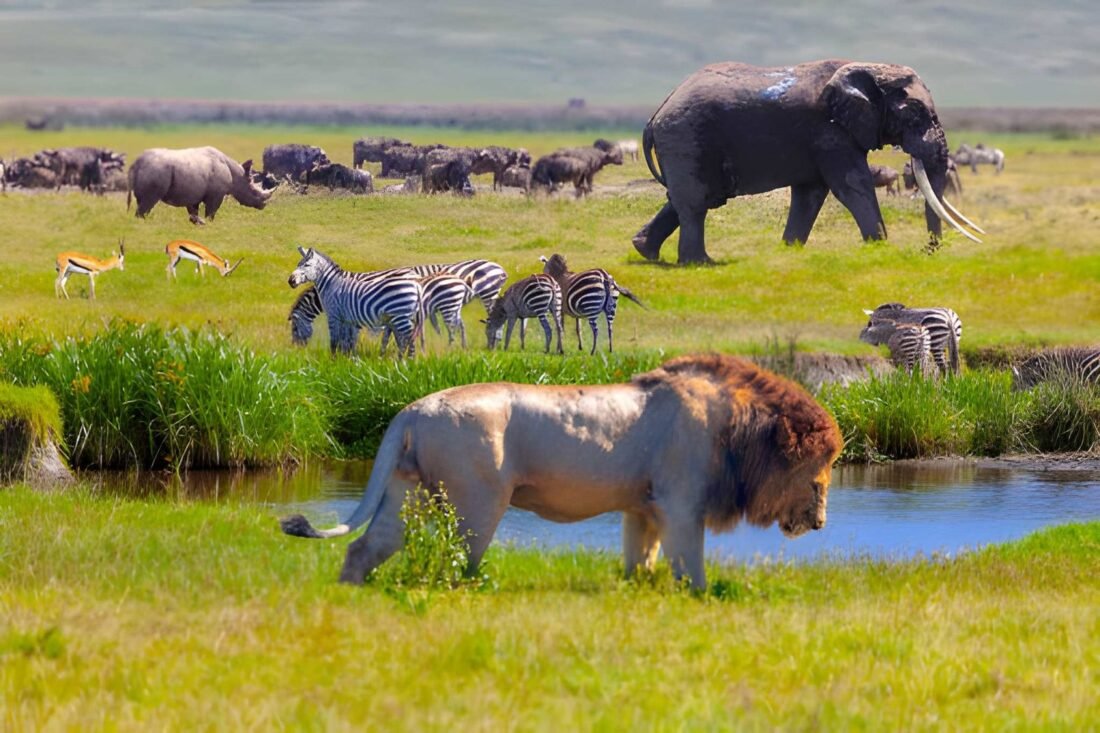
Wildlife commonly seen includes:
- Lions
- Leopards
- Cheetahs
- Elephants
- Buffalo
- Hippos
- Crocodiles
- Giraffes
- Hyenas
- Jackals
- Wildebeest
- Zebras
- Eland
- Topi
- Gazelles
Bird enthusiasts can also enjoy more than 500 recorded bird species.
For a deeper understanding of Tanzania’s extraordinary biodiversity, see our article on Faune de la Tanzanie : les cinq grands et au-delà.
Can You See the Big Five in the Serengeti?
Yes.
The Serengeti is one of the best places in Africa to see the famous Big Five.
The Big Five refers to:
Lion
The Serengeti is one of Africa’s greatest lion strongholds.
Seeing multiple lion prides during a safari is common.
Leopard
More elusive but regularly spotted, especially around the Seronera region.
Elephant
Large breeding herds roam throughout the ecosystem.
Buffalo
Extremely common and often seen in impressive numbers.
Rhinocéros noir
The rarest of the Big Five in the Serengeti.
Sightings are possible but less frequent.
Travelers hoping to maximize Big Five opportunities often combine Serengeti with Ngorongoro Crater, one of the best places in Tanzania to search for rhinos.
Why First-Time Visitors Fall in Love With the Serengeti
Many people arrive expecting wildlife.
What they do not expect is how the Serengeti makes them feel.
Modern life trains us to move quickly.
To check notifications.
To think about deadlines.
To focus on what comes next.
The Serengeti does the opposite.
Here, time slows down.
You wake before sunrise.
You watch light spread across the plains.
You spend hours observing a lion pride without looking at your phone.
You begin noticing details that normally pass unnoticed.
The sound of birds before dawn.
The movement of clouds over distant grasslands.
The cautious behavior of prey animals.
The confidence of predators.
For many travelers, this becomes the most memorable part of the safari.
Not the checklist.
Not the photographs.
Not even the migration.
The feeling of reconnecting with a world that still operates according to natural rhythms.
And that feeling is what keeps people dreaming about the Serengeti long after they return home.
The Different Regions of the Serengeti
One of the biggest mistakes first-time visitors make is assuming the Serengeti is one enormous, uniform grassland.
In reality, the park is incredibly diverse.
Different regions offer different landscapes, wildlife concentrations, migration activity, and overall safari experiences.
Understanding these regions can dramatically improve your trip planning.
Central Serengeti (Seronera)
If you are visiting the Serengeti for the first time, this is usually the best place to start.
The Seronera region sits at the heart of the park and offers some of the most reliable year-round wildlife viewing in Tanzania.
Unlike migration-dependent areas, Seronera maintains impressive resident wildlife populations throughout the year.
This means that even outside migration season, game viewing remains exceptional.
Highlights include:
- Lions
- Leopards
- Cheetahs
- Hyenas
- Hippos
- Elephants
- Resident wildebeest herds
Seronera is often described as the predator capital of the Serengeti.
For photographers, few places in Africa offer such consistent opportunities to observe predator behavior.
If your safari is limited to only a few days, prioritizing Central Serengeti is usually the safest choice.
Northern Serengeti
Northern Serengeti is famous for one reason above all others:
The Mara River crossings.
Between approximately July and October, vast herds gather along the riverbanks before attempting dramatic crossings into Kenya’s Maasai Mara ecosystem.
These crossings are unpredictable.
Sometimes herds wait for hours.
Sometimes for days.
And then, suddenly, thousands of animals charge into the water.
The spectacle is breathtaking.
Massive crocodiles lurk beneath the surface while predators patrol nearby.
Even outside migration season, Northern Serengeti remains one of the most beautiful and least crowded parts of the ecosystem.
Travelers seeking exclusivity often prefer this region.
Southern Serengeti
The southern plains offer an entirely different experience.
Between December and March, this region becomes the center of the migration calving season.
Hundreds of thousands of wildebeest give birth during a relatively short period.
For predators, this creates an abundance of hunting opportunities.
For visitors, it creates some of the most dramatic wildlife viewing of the year.
Lionesses with cubs.
Cheetahs hunting newborn calves.
Hyenas patrolling the plains.
Nature unfolds in its rawest form.
Many experienced safari guides consider calving season even more rewarding than the famous river crossings.
If you’re interested in this period, our Serengeti Low Season Green Season Safari Guide explains why many seasoned travelers deliberately choose these quieter months.
Western Corridor
The Western Corridor is often overlooked by first-time visitors.
That is a mistake.
This region follows the Grumeti River and plays a crucial role during migration movements between May and July.
The landscape differs significantly from the open central plains.
You’ll find:
- River systems
- Woodlands
- Dense vegetation
- Excellent birdlife
This diversity attracts a wide variety of wildlife.
The Grumeti River also hosts large crocodiles, creating dramatic migration scenes during crossing periods.
Eastern Serengeti
Far fewer visitors reach the eastern regions of the park.
This makes it ideal for travelers seeking solitude.
Game viewing remains excellent, particularly for cheetahs and other predators that favor open terrain.
The feeling of wilderness is often stronger here because vehicle density is significantly lower.
Best Time to Visit Serengeti National Park for Safari
One of the most common questions travelers ask is:
“When is the best time to visit the Serengeti?”
The honest answer is that there is no single best month.
The Serengeti offers remarkable wildlife viewing throughout the year.
The better question is:
“What experience are you looking for?”
Best Time for the Great Migration River Crossings
July to October
This period attracts visitors from around the world hoping to witness Mara River crossings.
Expect:
- High wildlife density
- Excellent predator action
- Dry conditions
- Peak-season pricing
Accommodation often sells out many months in advance.
Best Time for Calving Season
December to March
This is one of the most underrated periods to visit.
Benefits include:
- Thousands of newborn animals
- Outstanding predator activity
- Green landscapes
- Excellent photography conditions
Many wildlife photographers specifically target this period.
Best Time for Fewer Crowds
April, May, and November
These months receive fewer visitors.
Advantages include:
- Lower prices
- Fewer safari vehicles
- Beautiful green scenery
- More availability at premium lodges
Travelers looking to maximize value should also read our detailed Tanzania Safari Low Season Cost Guide.
Month-by-Month Serengeti Overview
January
Green landscapes.
Calving season begins.
Excellent predator sightings.
February
Peak calving season.
One of the best months for wildlife photography.
March
Outstanding game viewing.
Fewer visitors than peak season.
April
Rainfall increases.
Lush scenery dominates the plains.
May
Migration movement begins.
Excellent value for money.
June
Dry season starts.
Wildlife viewing improves further.
July
River crossing season develops.
High demand.
August
One of the most popular safari months.
September
Exceptional wildlife viewing.
Excellent weather.
October
Final major river crossings.
Dry conditions continue.
November
Short rains arrive.
Fewer tourists.
Beautiful photography opportunities.
December
Migration returns south.
Calving season approaches.
How Many Days Do You Need in the Serengeti?
This depends entirely on your goals.
Technically, you can visit the Serengeti in two days.
But should you?
Probably not.
The Serengeti rewards patience.
The longer you stay, the more memorable the experience becomes.
2 Days
Suitable for travelers with limited time.
Expect:
- Basic wildlife viewing
- Limited exploration
- Quick overview experience
3–4 Days
The minimum recommendation for most visitors.
Benefits include:
- Multiple game drives
- Better wildlife encounters
- Increased predator sightings
- Reduced pressure to rush
5–7 Days
Ideal for most safari enthusiasts.
This duration allows:
- Exploration of multiple regions
- Better migration opportunities
- More photography time
- Greater flexibility
If you’re unsure how long your safari should be overall, our comparison guide on Tanzania Safari: 5 vs 7 vs 10 Days breaks down the advantages of each option.
8+ Days
Perfect for photographers, wildlife enthusiasts, and repeat visitors.
The Serengeti never feels repetitive when explored at this pace.
Sample Serengeti Safari Itineraries
First-Time Visitor (3 Days)
Day 1:
- Arrive from Ngorongoro
- Afternoon game drive
Day 2:
- Full-day safari
Day 3:
- Sunrise game drive
- Departure
Classic Northern Circuit Safari (5–7 Days)
Day 1:
Tarangire National Park
Day 2:
Ngorongoro Highlands
Day 3:
Cratère de Ngorongoro
Day 4–6:
Serengeti National Park
Day 7:
Return to Arusha
For a detailed example, see our 7-Day Northern Circuit Tanzania Safari Itinerary.
Safari and Beach Combination
One of Tanzania’s greatest advantages is the ability to combine wildlife and tropical beaches within a single trip.
A popular itinerary includes:
- Serengeti
- Ngorongoro
- Zanzibar
If this combination interests you, explore our complete Tanzania Safari and Zanzibar Itinerary guide.
Many travelers consider it the perfect balance between adventure and relaxation.
How to Get to Serengeti National Park
By Road
Most visitors arrive via Tanzania’s Northern Safari Circuit.
Typical route:
Arusha → Tarangire → Ngorongoro → Serengeti
This remains the most popular safari route in the country.
If you’re spending time in northern Tanzania before your safari, our Arusha Travel Guide can help you plan your stay.
By Air
Several airstrips operate within the Serengeti.
Flying saves significant travel time and allows direct access to remote regions of the park.
This option is particularly popular among luxury travelers and those combining Serengeti with Zanzibar.
The flight itself often becomes part of the experience, offering spectacular aerial views of the plains below.
How Much Does a Serengeti Safari Cost?
One of the first questions travelers ask is:
“How much does it cost to visit the Serengeti?”
The answer depends on several factors:
- Time of year
- Safari duration
- Accommodation level
- Group size
- Transportation method
- Park fees
The Serengeti is not a budget destination in the traditional sense. Conservation fees, distances between parks, and logistics all contribute to overall costs.
However, there are options available for different budgets.
For a detailed breakdown of Tanzania-wide safari expenses, including park fees, accommodation, transportation, and seasonal variations, read our complete Tanzania Safari Cost Guide.
Budget Serengeti Safari
Budget travelers typically join shared safaris and stay in public or basic tented camps.
Expect:
- Shared vehicles
- Simple accommodations
- Fixed itineraries
- Lower overall costs
This option allows travelers to experience the Serengeti without sacrificing wildlife viewing quality.
If affordability is your priority, our Budget Safari Options in Tanzania guide explores the best ways to reduce costs without compromising the experience.
Mid-Range Serengeti Safari
This is the category chosen by most international visitors.
Expect:
- Comfortable lodges or tented camps
- Professional safari guides
- Better food and service
- Private bathroom facilities
- Excellent locations
For most travelers, mid-range safaris provide the best balance between comfort and value.
Luxury Serengeti Safari
Luxury safaris elevate the experience significantly.
Typical features include:
- Premium tented camps
- Fine dining
- Fly-in safaris
- Private guides
- Exclusive wildlife areas
- Personalized service
Luxury in the Serengeti is not about marble floors or city-style hotels.
It is about waking up surrounded by wilderness while enjoying exceptional comfort.
Where to Stay in the Serengeti
Choosing where to stay is just as important as choosing when to visit.
The best accommodation depends on your travel style, budget, and safari goals.
Unlike city hotels, safari accommodations are part of the experience itself.
Many visitors remember their lodge almost as vividly as the wildlife.
Tented Camps
The classic Serengeti experience.
Modern tented camps offer:
- Comfortable beds
- Private bathrooms
- Hot showers
- Dining facilities
- Outstanding locations
You hear nature around you while remaining comfortable and safe.
For many travelers, this is the most authentic safari accommodation option.
Safari Lodges
Lodges provide additional comfort and amenities.
They often include:
- Swimming pools
- Larger rooms
- Permanent structures
- Panoramic views
- Family-friendly facilities
Travelers comparing accommodation styles should also read Lodge Safari vs Camping Safari in Tanzania.
Eco-Lodges
Sustainable tourism is becoming increasingly important in Tanzania.
Eco-lodges focus on:
- Environmental conservation
- Community support
- Responsible tourism practices
- Reduced environmental impact
If sustainability matters to you, explore our guide to the Les meilleurs Eco Lodges à Serengeti.
These properties prove that luxury and conservation can successfully coexist.
Serengeti vs Ngorongoro Crater
This is one of the most common safari planning questions.
Which is better?
The truth is that they offer completely different experiences.
Serengeti
Best for:
- Endless landscapes
- Large predator populations
- The Great Migration
- Multi-day safaris
- Classic safari atmosphere
Cratère de Ngorongoro
Best for:
- Dense wildlife concentrations
- Big Five opportunities
- Day trips
- Rhino sightings
- Spectacular crater scenery
The Serengeti feels limitless.
Ngorongoro feels concentrated.
Most safari experts recommend visiting both.
For a deeper look at the crater experience, see our complete Ngorongoro Crater Safari Guide.
Serengeti vs Tarangire National Park
Another common comparison involves Tarangire.
While Tarangire receives less international attention, it remains one of Tanzania’s most rewarding parks.
Serengeti
Known for:
- Migration
- Predators
- Vast plains
- Iconic safari landscapes
Tarangire
Known for:
- Massive elephant herds
- Ancient baobab trees
- Excellent dry-season wildlife
- Lower visitor numbers
Many travelers begin their Northern Circuit adventure in Tarangire before continuing to Serengeti.
To learn more, visit our detailed Tarangire National Park Safari Guide.
What Should You Pack for the Serengeti?
Packing correctly can dramatically improve your safari experience.
Fortunately, you do not need specialized expedition equipment.
The essentials include:
Clothing
- Neutral-colored clothing
- Light layers
- Warm jacket for mornings
- Comfortable trousers
- Sun hat
Equipment
- Binoculars
- Camera
- Power bank
- Spare memory cards
Health Essentials
- Sunscreen
- Insect repellent
- Personal medications
For a complete checklist, read our detailed Tanzania Safari Packing List.
Many first-time visitors either overpack or bring unsuitable clothing.
A proper packing list eliminates unnecessary stress.
Common Mistakes First-Time Serengeti Visitors Make
Trying to See Everything Too Quickly
The Serengeti rewards patience.
Rushing through the park often reduces wildlife opportunities.
Choosing the Wrong Season
Not every month offers the same experience.
Researching migration movements before booking is essential.
Our Best Time to Visit Tanzania guide can help align travel dates with your priorities.
Underestimating Distances
The Serengeti is enormous.
Travel times between regions can be longer than expected.
Focusing Only on the Migration
Many travelers become obsessed with river crossings.
In reality, predator sightings, landscapes, and everyday wildlife encounters often become the most memorable parts of the safari.
Booking Too Late
Popular camps and lodges can fill months in advance.
This is especially true during peak migration season.
Is the Serengeti Worth Visiting?
Absolutely.
In fact, for many travelers, it becomes the highlight of their entire African journey.
The Serengeti is not merely a national park.
It is one of the last places on Earth where wildlife still exists on a scale that feels almost prehistoric.
There are very few destinations capable of changing the way we see nature.
The Serengeti is one of them.
Whether you witness a lion hunt at sunrise, watch elephants cross the plains, or simply sit quietly as thousands of wildebeest move across the horizon, you begin to understand why this landscape has inspired travelers, conservationists, photographers, and filmmakers for generations.
The Serengeti does not simply show you wildlife.
It reminds you how extraordinary the natural world truly is.
Frequently Asked Questions
How many days should I spend in Serengeti?
Most travelers should spend at least three to four days.
Five to seven days provides a much deeper experience.
Can I see the Big Five in Serengeti?
Yes.
The Serengeti is one of Africa’s best destinations for seeing the Big Five, although rhino sightings are less common than lion, elephant, buffalo, and leopard sightings.
What is the best month to visit Serengeti?
There is no single best month.
July to October is ideal for river crossings, while December to March is excellent for calving season and predator activity.
Is Serengeti suitable for first-time safari travelers?
Absolutely.
In fact, many experts consider it the best first safari destination in Africa.
If this is your first safari, our Tanzania Safari Guide for First Timers will help you understand exactly what to expect.
Can I combine Serengeti with Zanzibar?
Yes.
This is one of Tanzania’s most popular itineraries.
After several days of wildlife viewing, travelers often continue to Zanzibar for beaches, relaxation, and cultural experiences.
Our Tanzania Safari and Zanzibar Itinerary explains how to combine both destinations efficiently.
Final Thoughts
There are countless places in the world where you can see animals.
There are very few places where you can feel completely immersed in nature.
The Serengeti belongs to that rare category.
It is a place where every sunrise brings possibility.
Where every game drive tells a different story.
Where lions, elephants, cheetahs, and wildebeest still live according to rhythms that have remained unchanged for centuries.
For first-time visitors, it often exceeds expectations.
For returning travelers, it somehow becomes even more meaningful.
And long after your safari ends, long after you return home and resume daily life, chances are you will still find yourself thinking about those endless plains.
Because the Serengeti is not simply a destination.
It is an experience that stays with you forever.
The Serengeti Isn’t a Place You’ll Forget
Years from now, you probably won’t remember another hotel room.
You won’t remember another airport.
You won’t remember another ordinary vacation.
But you’ll remember the moment a lion appeared beside your vehicle at sunrise.
You’ll remember watching elephants disappear into the golden grass.
You’ll remember the silence before a wildebeest crossing.
And you’ll remember the feeling of standing in one of the last truly wild places on Earth.
The Serengeti is not a trip.
It’s a story you’ll be telling for the rest of your life.
If you’re ready to start planning your own Tanzania adventure, we’re here to help.
At Nomadic Routes, we design tailor-made safaris built around your interests, travel style, and budget—whether you’re dreaming of the Great Migration, a luxury honeymoon, a family safari, or a complete Serengeti and Zanzibar journey.
Your adventure starts with a simple conversation.
No pressure. No obligation. Just expert advice for your dream safari.