
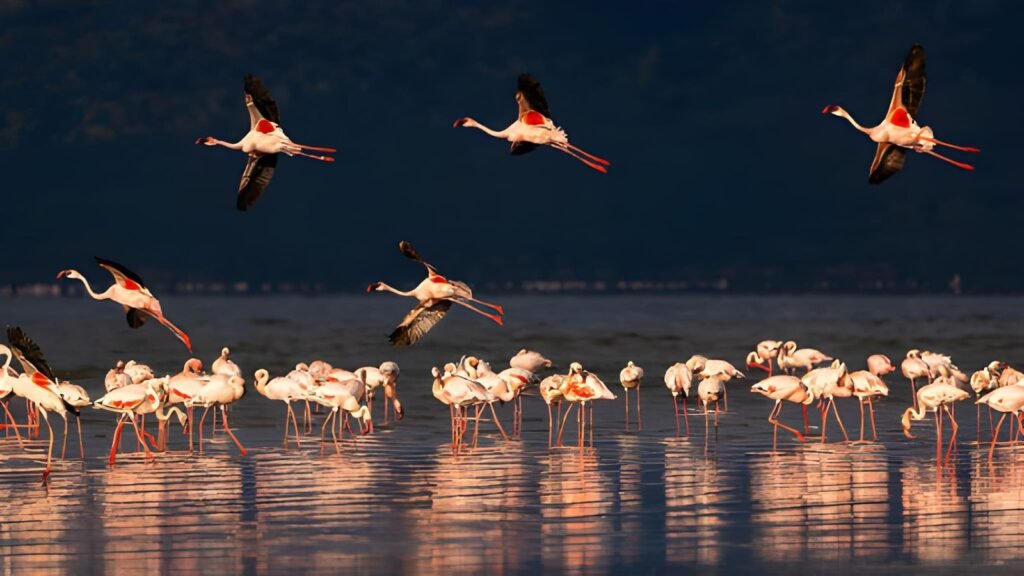
Lake Natron is one of the most unusual destinations in northern Tanzania.
Instead of the classic safari landscape of endless grasslands and large herds, this remote area combines an alkaline lake, vast flocks of lesser flamingos, volcanic landscapes, Maasai culture and the dramatic presence of Ol Doinyo Lengai, Tanzania’s active volcano.
Lake Natron is also much less conventional than destinations such as Serengeti or Ngorongoro. The experience here is about getting away from the standard safari route and exploring a landscape shaped by the Great Rift Valley.
The Lake Natron Game Controlled Area covers approximately 3,000 km² and is managed within Tanzania’s wildlife conservation system. TAWA identifies Lake Natron as a Game Controlled Area rather than a national park.
If you are looking for flamingos, volcanic scenery, hiking and a more remote Tanzania experience, Lake Natron deserves serious consideration.
Where Is Lake Natron?
Lake Natron is in northern Tanzania, in the Arusha region, close to the Kenyan border.
The lake sits in the Great Rift Valley, between the Monduli and Longido areas to the east and the Ngorongoro area to the west. TAWA places the Lake Natron Game Controlled Area at approximately 2°30′S, 36°E.
The lake itself is approximately 57 km long and up to 22 km wide, although its appearance changes considerably depending on water levels.
The landscape is very different from the lush areas many first-time visitors associate with Tanzania. It is hot, dry and volcanic, with mountains, escarpments, alkaline water and wide open plains.
For travelers coming from Arusha, access is generally by road through the northern Tanzania landscape, with routes passing through the Manyara/Mto wa Mbu area before continuing toward Lake Natron. TAWA confirms road access from Arusha through the Manyara or Mto wa Mbu direction.
Why Is Lake Natron Famous?
Lake Natron is best known for three things:
- Lesser flamingos
- Its highly alkaline environment
- Its proximity to Ol Doinyo Lengai
The lake is shallow and highly alkaline, with TAWA reporting pH levels that can reach approximately 9.5–12. Temperatures around the lake can also become extremely high.
This harsh environment might seem inhospitable, but it supports one of the most important breeding sites for lesser flamingos.
Lake Natron Flamingos
For many visitors, the flamingos are the main reason to visit Lake Natron.
TAWA describes Lake Natron as the most important breeding site for lesser flamingos in the world, noting that a large proportion of the global population is associated with the lake.
The birds feed on the algae found in the lake’s alkaline waters.
This creates one of the most spectacular scenes in northern Tanzania: thousands of flamingos against a backdrop of volcanic mountains and the Rift Valley.
However, flamingo numbers and breeding activity are not identical throughout the year. TAWA notes that breeding can occur throughout the year when conditions are suitable, with breeding periods influenced by seasonal rainfall.
So if seeing large concentrations of flamingos is your priority, your itinerary should be planned around current local conditions rather than relying only on a generic “best month” rule.
Is Lake Natron Really Dangerous?
Lake Natron has developed a reputation online as a place where animals can supposedly be “turned to stone.”
That description is misleading.
The lake is extremely alkaline and saline, and its chemical environment is harsh. It is not a normal freshwater swimming lake.
The important point for travelers is simple:
Do not treat Lake Natron like a conventional swimming destination.
The attraction is its unique ecosystem, flamingos, landscapes and surrounding activities—not swimming in the lake itself.
There are other natural water features in the area, including waterfalls and hot and cold springs, that can be incorporated into a visit. TAWA specifically lists waterfalls around Engaresero and hot and cold springs among the area’s attractions.
Ol Doinyo Lengai: Tanzania’s Active Volcano
Rising dramatically above the Lake Natron landscape is Ol Doinyo Lengai, a volcano whose name is commonly translated from Maasai as the “Mountain of God.”
TAWA identifies Ol Doinyo Lengai as an active volcano near Lake Natron and notes that it is notable for its unusual natrocarbonatite lava. TAWA records its last major eruption as occurring in 2006.
The volcano reaches approximately 2,962 metres above sea level.
For travelers, the attraction is not only the summit itself. The climb offers a completely different perspective on northern Tanzania, with views across the Rift Valley and Lake Natron.
Can You Climb Ol Doinyo Lengai?
Yes, mountain climbing is one of the activities identified by TAWA in the Lake Natron area.
TAWA specifically lists mountain climbing on Ol Doinyo Lengai and describes the opportunity to experience sunrise and volcanic landscapes from the mountain.
But this is not a casual sightseeing walk.
The terrain, heat, elevation gain and early start make the climb considerably more demanding than a normal nature walk around Lake Natron.
If you plan to climb Ol Doinyo Lengai, arrange the trek locally in advance and follow the current guidance of your local mountain guide and the relevant authorities.
Important: the TAWA tariff document available to us does not give a separate line item specifically named “Ol Doinyo Lengai climbing fee.” It does provide a general hiking and walking-safari fee for the relevant category of conservation areas. Therefore, we should not present that hiking fee as the complete cost of climbing the volcano.
Things to Do in Lake Natron
Lake Natron is more than a flamingo-viewing stop.
1. Flamingo Watching
Visit the lake shore with a guide to look for lesser flamingos and other birdlife.
TAWA lists flamingo watching among the area’s principal tourism activities.
2. Climb Ol Doinyo Lengai
For adventurous travelers, the volcano is one of the area’s biggest attractions.
The experience combines physical challenge, sunrise views and a unique volcanic landscape.
3. Explore the Rift Valley Landscape
The Lake Natron area contains dramatic geological features including escarpments, craters, caves, canyons and plains.
4. Visit Waterfalls
Waterfalls around Engaresero provide another way to experience the landscape and can offer opportunities for swimming and nature appreciation.
5. Experience Maasai Culture
The area is also home to important Maasai cultural experiences.
Visitors can encounter traditional architecture, crafts, food, clothing, dances, songs and other aspects of local culture.
A cultural visit should always be arranged respectfully through appropriate local hosts rather than treating communities as a tourist attraction.
6. Wildlife and Birdwatching
Although Lake Natron is not a conventional Big Five safari destination, TAWA records wildlife including zebra, wildebeest, giraffe, gazelles, buffalo, eland, oryx, impala, hyena and other species within the wider area.
Best Time to Visit Lake Natron
Lake Natron is hot for much of the year, particularly around the lake itself.
TAWA describes the area as one of the hottest and driest parts of northern Tanzania, with temperatures that can exceed 40°C in some periods.
The area receives irregular seasonal rainfall, and conditions can influence both road access and flamingo breeding activity.
For this reason, the best time depends on what you want to do.
For flamingos
The lake can support flamingo breeding throughout the year when conditions are suitable, so there is no simple one-month guarantee.
For climbing Ol Doinyo Lengai
The priority should be suitable climbing conditions and current local advice rather than choosing a month solely because it is labeled “dry season.”
For combining Lake Natron with a safari
Your overall Tanzania itinerary matters more.
You may want to combine Natron with destinations such as Serengeti or Ngorongoro rather than treating the lake as an isolated trip.
For broader seasonal planning, see the Best Time to Visit Tanzania guide.
Best Time to Visit Tanzania for Safari, Kilimanjaro & Zanzibar
How Much Does a Lake Natron Trip Cost?
There is no single “Lake Natron safari price.”
Your total cost depends on:
- Transportation
- Accommodation
- Number of nights
- Private or shared travel
- Guide services
- activités
- Ol Doinyo Lengai arrangements
- Other safari destinations included in the itinerary
It is also important to separate TAWA conservation fees from the price charged by a safari operator.
TAWA Fees for International Visitors
The TAWA regulations currently available to us are from Government Notice No. 875, published in October 2024. The regulations specify that fees for Game Controlled Areas are prescribed under the Fourth Schedule.
For the general GCA category, the published rates for Non-EA citizens include:
| Fee | Adult | Child 5–15 |
|---|---|---|
| Conservation fee | TZS 30,000 (~US$11.24) | TZS 20,000 (~US$7.49) |
| Night game drive | TZS 50,000 (~US$18.72) | TZS 30,000 (~US$11.24) |
| Hiking / walking safari | TZS 35,000 (~US$13.11) | TZS 25,000 (~US$9.36) |
| Public camping | TZS 75,000/night (~US$28.09) | TZS 45,000/night (~US$16.85) |
Children below five years are listed as free for the applicable conservation, night game drive, hiking and public camping categories.
TAWA also lists a tour guide and armed ranger service fee of TZS 100,000 for groups of 1–6 people in the relevant category.
USD conversion
The approximate USD figures above use:
US$1 = TZS 2,670.23 — August 15, 2026.
Exchange rates change, so the USD equivalents are provided only as a reference. The TZS amount is the underlying published fee.
Important note about the 2026/27 rates
The source available to us is the 2024 TAWA Government Notice, not a newly issued 2026/27 tariff. Therefore, these should be described as TAWA’s published rates from the available regulation, rather than claiming that TAWA officially issued a new 2026/27 tariff.
A safari quotation may also include other costs that do not appear in these conservation fees.
How Many Days Do You Need in Lake Natron?
For most travelers, 2–3 nights can make sense if Lake Natron is an important part of the itinerary.
A simple visit could include:
Day 1:
Arusha → Lake Natron → afternoon exploration
Day 2:
Flamingo viewing → nature walk/waterfalls → Maasai cultural experience
Day 3:
Ol Doinyo Lengai trek or departure toward the next destination
The exact structure depends heavily on whether you are climbing the volcano.
If Ol Doinyo Lengai is the main objective, you should allow additional flexibility rather than treating the area as a quick one-night stop.
Can You Combine Lake Natron With a Tanzania Safari?
Absolutely.
This is where Lake Natron becomes particularly interesting for travelers who want something beyond the standard northern safari circuit.
You can potentially combine it with:
Lake Natron + Ngorongoro
A strong combination for travelers interested in wildlife and dramatic landscapes.
Ngorongoro Crater Safari Guide
Lake Natron + Serengeti
This combines one of Tanzania’s most unusual landscapes with one of Africa’s most famous safari destinations.
Serengeti National Park Safari Guide
Lake Natron + a Northern Tanzania Safari
If you want to understand how Natron fits into the wider region, compare the different safari areas before building your itinerary.
Northern vs Southern Tanzania Safari
Is Lake Natron Worth Visiting?
Yes—if you are looking for something different from a traditional safari.
Lake Natron is particularly attractive for travelers who enjoy:
- Dramatic landscapes
- Birdwatching
- Flamingos
- Volcanoes
- Hiking
- Photography
- Cultural experiences
- Remote destinations
It is probably not the best choice if your only objective is to maximize Big Five sightings in a short trip.
For that, destinations such as Serengeti and Ngorongoro are more obvious choices.
Lake Natron’s strength is its combination of experiences.
You are not simply visiting a lake.
You are entering a volcanic Rift Valley landscape where flamingos, Maasai culture, mountains, wildlife and one of Tanzania’s most unusual geological environments come together.
Frequently Asked Questions About Lake Natron
Is Lake Natron a national park?
No. TAWA classifies Lake Natron as a Game Controlled Area, not a national park. The Lake Natron Game Controlled Area covers approximately 3,000 km².
Why is Lake Natron famous?
It is particularly famous for its alkaline environment, lesser flamingos and its location near Ol Doinyo Lengai. TAWA describes it as a globally important breeding site for lesser flamingos.
Can you visit Lake Natron without doing a safari?
Yes. The area offers several experiences beyond conventional game drives, including flamingo watching, hiking, waterfalls, cultural experiences and mountain climbing.
Can you climb Ol Doinyo Lengai?
Mountain climbing on Ol Doinyo Lengai is one of the activities identified by TAWA in the Lake Natron area.
Is Lake Natron worth adding to a Tanzania itinerary?
For travelers interested in volcanic landscapes, flamingos, hiking and less conventional destinations, it can be an excellent addition. It works particularly well when combined with other northern Tanzania destinations.
Planning a Lake Natron Adventure?
Lake Natron is not a standard safari stop. The logistics matter, especially if you want to combine the lake with Ol Doinyo Lengai, a northern Tanzania safari or Zanzibar.
Instead of trying to fit everything together yourself, you can have a tailor-made itinerary built around your travel dates, interests and budget.
Private safaris · Tailor-made Tanzania trips · Safari & Zanzibar itineraries