Mount Meru is one of Tanzania’s most underrated mountain adventures.
It stands in Arusha National Park, close to Arusha and within easy reach of Kilimanjaro International Airport. At about 4,565–4,566 meters, it is Tanzania’s second-highest mountain and a dramatic free-standing volcano.
Yet Mount Meru offers something that Kilimanjaro cannot quite replicate.
The trek combines a high-altitude mountain climb with volcanic scenery, crater walls, forest, wildlife and spectacular views toward Mount Kilimanjaro.
It can also be an excellent way to experience high-altitude trekking before attempting Kilimanjaro.
However, Mount Meru should not be treated as simply a shorter Kilimanjaro.
It is a demanding mountain in its own right.
This complete Mount Meru Climb Guide covers the route, itinerary, difficulty, altitude, accommodation, wildlife, safety, preparation, costs and the practical details you need before booking your trek.
Mount Meru at a Glance
| Detail | Mount Meru |
|---|---|
| Location | Arusha National Park, Tanzania |
| Elevation | About 4,565–4,566 m |
| Highest point | Socialist Peak |
| Main route | Momella Route |
| Main starting point | Momella Gate |
| Main mountain huts | Miriakamba and Saddle |
| Typical itinerary | 3–4 days |
| Terrain | Forest, moorland, volcanic terrain and exposed ridge |
| Technical climbing | Not normally required on the standard trekking route |
| Wildlife | Possible, especially on lower sections |
| Major view | Mount Kilimanjaro |
| Gateway city | Arusha |
TANAPA’s current park material identifies Mount Meru as the dominant feature of Arusha National Park. Its official Geopark information also describes the mountain as a free-standing stratovolcano with Big Meru, Little Meru and the Ash Cone.
Why Climb Mount Meru?
There are several good reasons to choose Mount Meru.
The first is its combination of mountain scenery and wildlife.
The second is its volcanic landscape.
The third is its proximity to Arusha.
And finally, it offers a genuine high-altitude trekking experience without requiring a technical climbing expedition on the standard route.
A mountain with a different character
Mount Meru has a very different personality from Kilimanjaro.
Kilimanjaro is famous because it is the highest mountain in Africa.
Mount Meru is more about the journey itself.
The trail moves through changing vegetation zones before reaching the higher mountain terrain. As you climb, the forest gives way to more open landscapes and eventually to the dramatic summit ridge.
TANAPA describes Meru’s landscape as the result of major volcanic activity and an enormous eastern-wall collapse that created its distinctive horseshoe-shaped crater.
That geological history is visible throughout the trek.
Mount Meru and Arusha National Park
One of the biggest advantages of Mount Meru is its location.
The mountain is inside Arusha National Park, rather than in a completely isolated trekking area.
This means the climb begins in an environment where wildlife and mountain landscapes exist side by side.
TANAPA lists giraffes, elephants, buffaloes, waterbuck, baboons, monkeys and other wildlife among the park’s species. The park is also particularly known for its black-and-white colobus monkeys.
Wildlife sightings are never guaranteed.
Still, the possibility of encountering animals on the lower sections gives Mount Meru a character that is unusual for a mountain trek.
You are not simply walking through a mountain corridor.
You are climbing through a protected ecosystem.
Mount Meru’s Volcanic Landscape
Mount Meru is a volcano with a remarkable geological structure.
Its most distinctive feature is the enormous horseshoe-shaped scar created by the collapse of the eastern side of the mountain.
TANAPA’s Geopark information identifies several important features:
- Big Meru
- Little Meru
- The Ash Cone
- The crater
- Volcanic lava and ash deposits
- Debris-avalanche deposits
- Volcanic formations and geological layers
This makes the climb interesting even for travelers who are fascinated by geology.
You can actually see evidence of the mountain’s volcanic history rather than simply hearing about it.
Socialist Peak
Socialist Peak is the highest point of Mount Meru.
TANAPA places the mountain at approximately 4,565 meters in its Geopark description and 4,566 meters in another official publication.
The summit is located on the dramatic upper ridge.
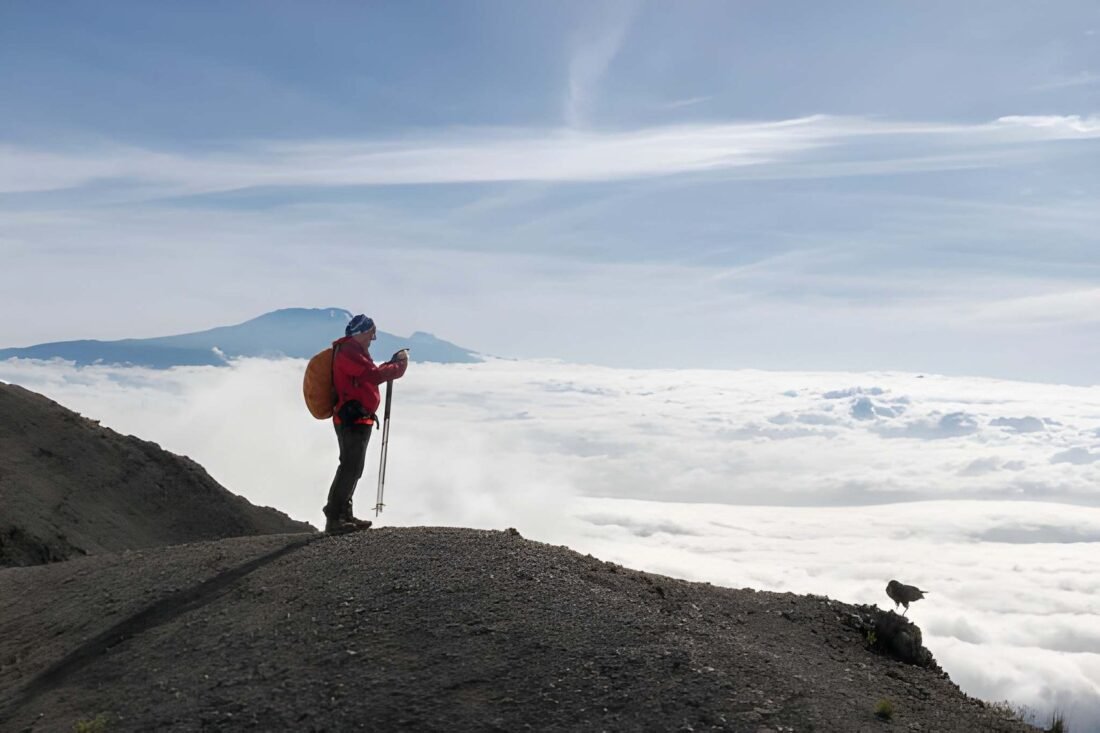
One of the most memorable experiences is reaching the summit around sunrise.
When visibility is good, Mount Kilimanjaro can be seen from Socialist Peak.
TANAPA specifically highlights the view of Kilimanjaro and the triangular shadow that can appear during sunrise.
Little Meru
Little Meru is another volcanic cone on the mountain.
It reaches approximately 3,800 meters.
TANAPA describes it as a volcanic cone northeast of the main Meru cone. Its summit provides views toward the north, including Mount Oldoinyo Lengai when conditions allow.
Little Meru is also important because it forms part of the upper-mountain experience before the final summit.
The Ash Cone
The Ash Cone is one of Mount Meru’s most striking geological features.
TANAPA describes it as a pyramid-shaped ash and cinder cone rising from the crater floor. It is approximately 1.5 km wide and rises around 200 meters above the crater floor.
From the upper mountain, the Ash Cone contributes to the dramatic volcanic scenery.
This is one reason Mount Meru appeals to travelers who want more than a conventional summit trek.
Where Does the Mount Meru Climb Start?
The standard Mount Meru trek begins at Momella Gate.
The route then climbs through the mountain’s different ecological zones toward the mountain huts and eventually the summit.
TANAPA’s official Arusha National Park map identifies:
- Momella Gate
- Miriakamba
- Saddle
- Little Meru
- Summit
- Mountain trails
- Various park facilities and attractions.
The mountain trek therefore has a clear progression.
You begin in the lower park.
You climb through forest.
You reach the higher mountain environment.
Then you tackle the summit ridge.
How Many Days Do You Need for Mount Meru?
Mount Meru is commonly sold as a 3- or 4-day trek.
However, TANAPA’s own recent investment material describes the mountain hike as a 4-day adventure using Miriakamba and Saddle huts. It also states that the hike must be prearranged through a local tour operator and requires porters and an armed Ranger escort.
That makes the four-day itinerary the more useful baseline for this guide.
A shorter itinerary may exist through operators, but travelers should not assume that every 3-day itinerary has the same structure or acclimatization profile.
For most people, four days is the better choice.
4-Day Mount Meru Climb Itinerary
Day 1: Momella Gate to Miriakamba Hut
Your Mount Meru adventure begins at Momella Gate.
After completing the necessary park procedures, you start walking through the lower slopes of the mountain.
This section is one of the most interesting parts of the trek because you are still within the wildlife-rich environment of Arusha National Park.
You may encounter animals along the route.
However, wildlife encounters are not guaranteed.
The trail gradually climbs through forest and changing vegetation until you reach Miriakamba Hut.
This is your first mountain overnight stop.
The objective on the first day is not speed.
It is to establish a steady rhythm and conserve energy for the higher sections of the mountain.
Overnight: Miriakamba
Miriakamba is one of the mountain huts shown on TANAPA’s official Arusha National Park map.
Accommodation here is basic.
Do not expect a luxury lodge.
The huts exist to provide practical shelter for trekkers.
That is part of the Mount Meru experience.
Day 2: Miriakamba to Saddle Hut
The second day takes you higher toward Saddle Hut.
The vegetation gradually changes as the altitude increases.
The environment becomes more open, and the mountain begins to feel more exposed.
This is also when pacing becomes increasingly important.
You may feel physically capable of walking quickly.
However, altitude changes the equation.
A slow and consistent pace is usually more useful than pushing hard early in the day.
TANAPA’s official material identifies Saddle as one of the key mountain facilities on the Mount Meru route.
Little Meru option
Depending on the itinerary and conditions, trekkers may also visit Little Meru.
At about 3,800 meters, it provides an additional high-altitude viewpoint.
However, it should not become a forced objective.
If you are tired or experiencing symptoms of altitude illness, discuss the situation with your guide rather than adding unnecessary exertion.
Day 3: Summit Day
Summit day is the hardest part of the Mount Meru climb.
The start is usually very early, often during the night.
The reason is simple.
Starting early gives trekkers the opportunity to reach the upper ridge around sunrise.
From Saddle Hut, the route continues upward toward the summit ridge.
The terrain becomes steeper and more exposed.
At this altitude, the cold can also become a significant factor.
You need to manage:
- Pace
- Breathing
- Hydration
- Cold
- Fatigue
- Altitude symptoms
- Weather conditions
The final ascent is not technical climbing in the conventional mountaineering sense.
Nevertheless, it is physically demanding.
The combination of steep terrain, darkness, cold and altitude can make summit day much harder than the previous stages.
Reaching Socialist Peak
Standing on Socialist Peak is the defining moment of the climb.
The mountain opens up around you.
If the weather cooperates, you may see Kilimanjaro across the surrounding landscape.
TANAPA specifically identifies the Kilimanjaro view from Socialist Peak as one of Mount Meru’s major attractions.
Take your time at the summit.
Do not rush the experience.
After reaching the summit, you begin the descent.
Day 4: Descent to Momella Gate
The final day is primarily a descent.
That sounds easier than climbing.
In reality, descending after several days on the mountain can be physically demanding.
Your legs have already accumulated fatigue.
Knees and ankles can become particularly important during the downhill sections.
A controlled pace is therefore better than trying to finish as quickly as possible.
Eventually, you return to Momella Gate.
The mountain experience ends where it began.
Is Mount Meru Difficult?
Yes.
Mount Meru is not an easy day hike.
The altitude alone makes the trek significantly more demanding than a normal mountain walk.
The summit is above 4,500 meters, and the final ascent takes place after several days of trekking.
The difficulty comes from several factors:
Altitude
At more than 4,500 meters, the amount of available oxygen is much lower than at sea level.
Steep terrain
The upper mountain becomes considerably steeper.
Long summit day
The summit attempt begins very early and combines ascent with altitude and cold.
Weather
Mountain conditions can change quickly.
Fatigue
By summit day, you have already spent several days walking.
That is why physical preparation matters.
Do You Need Technical Climbing Experience?
For the standard Mount Meru trekking route, technical mountaineering experience is not normally required.
However, that should never be interpreted as meaning that the trek is easy.
The route requires good physical fitness, preparation and the ability to handle sustained uphill walking.
More importantly, TANAPA states that the Mount Meru mountain hike must be prearranged by a local tour operator and accompanied by porters and an armed Ranger escort.
This is an important practical distinction.
Mount Meru is not a mountain where international visitors should simply arrive at the gate and attempt to organize an independent climb.
Mount Meru and Wildlife
One of the most distinctive features of the trek is the possibility of seeing wildlife.
Arusha National Park supports a wide range of animals.
TANAPA lists:
- Giraffes
- Elephants
- Buffaloes
- Waterbuck
- Baboons
- Monkeys
- Bushbuck
- Duiker
- Hippopotamus in suitable park areas
- Numerous bird species
The lower sections of the mountain are particularly relevant for wildlife encounters.
However, there is an important safety point.
You are not on a normal independent hiking trail.
TANAPA states that mountain hiking in the park requires an armed Ranger escort.
That is one reason the Mount Meru experience differs from many conventional mountain hikes around the world.
Mount Meru vs Kilimanjaro
Mount Meru and Kilimanjaro are often compared.
That makes sense because both are in northern Tanzania.
However, they offer different experiences.
| Mount Meru | Kilimanjaro | |
|---|---|---|
| Highest point | About 4,565–4,566 m | 5,895 m |
| Location | Arusha National Park | Kilimanjaro National Park |
| Main character | Volcano, crater, wildlife and ridge | Africa’s highest summit |
| Typical Meru itinerary | About 4 days | Usually longer |
| Wildlife | Possible on lower sections | Less central to the trek |
| Main summit | Socialist Peak | Uhuru Peak |
| Standard route | Momella Route | Several trekking routes |
Mount Meru is therefore not simply a cheaper Kilimanjaro.
It offers its own experience.
If your main goal is to stand on the highest mountain in Africa, Kilimanjaro is the obvious choice.
If you want a shorter mountain adventure with volcanic scenery, wildlife and views toward Kilimanjaro, Meru can be a very attractive alternative.
For travelers comparing Kilimanjaro routes, our Machame vs Lemosho Route Guide is a useful next step.
Is Mount Meru Good Preparation for Kilimanjaro?
It can be.
Mount Meru gives you experience with:
- Multi-day trekking
- Mountain huts
- Early summit starts
- Cold conditions
- Altitude
- Pacing
- Carrying a daypack
- Following a mountain guide
- Managing fatigue
That experience can be valuable before a Kilimanjaro expedition.
However, Mount Meru does not guarantee that you will avoid altitude illness on Kilimanjaro.
Altitude illness depends on several factors, including the rate of ascent and individual susceptibility.
Therefore, climbing Meru should be viewed as useful trekking experience, not as insurance against altitude sickness.
For a detailed explanation of altitude sickness, see our Acute Mountain Sickness on Kilimanjaro guide.
Who Should Climb Mount Meru?
Mount Meru is a strong choice for travelers who:
- Want a genuine mountain challenge.
- Prefer a shorter trek.
- Enjoy volcanic landscapes.
- Want the possibility of wildlife encounters.
- Want views of Kilimanjaro.
- Are considering Kilimanjaro afterward.
- Have enough time to prepare physically.
It may be less suitable for travelers who are looking for a completely relaxed hiking holiday.
The mountain requires effort.
It also requires respect.
Who Should Not Treat Mount Meru as an Easy Hike?
You should reconsider the trek if you are expecting:
- A casual walk
- Guaranteed wildlife sightings
- Lodge-style accommodation on the mountain
- No altitude exposure
- No early morning summit
- No steep sections
Mount Meru is a real high-altitude mountain.
That is exactly what makes it worthwhile.
Internal link opportunity
If you are planning Mount Meru as part of a larger Tanzania trip, you can continue with our Tanzania Travel Planning Guide.
If the goal is Kilimanjaro afterward, read the Kilimanjaro Climbing Guide and compare the Machame vs Lemosho routes before choosing your expedition.
Part 2 — Mount Meru Cost, Accommodation, Preparation & Safety
How Much Does a Mount Meru Climb Cost?
The total cost of a Mount Meru climb depends on what is included in your trekking package.
TANAPA fees are only one part of the total cost. Your tour operator may also charge for or include services such as guides, porters, meals, transportation, accommodation and other trekking services.
Official TANAPA Fees for Mount Meru
The official TANAPA tariff figures below apply to the 2026/2027 tariff year, from July 1, 2026 to June 30, 2027.
To make the official fees easier to understand for international travelers, we show the original amounts in Tanzanian shillings (TZS) together with their USD equivalents.
For this guide, the USD conversions use:
1 USD = TZS 2,630
Important: The USD amounts below are TANAPA fee equivalents only. They are not the final price of a Mount Meru trekking package. Your total trip cost will depend on the services included by your tour operator.
The original TZS amounts are retained so you can verify each conversion.
Mount Meru Hut Fees
Mount Meru uses mountain huts rather than tent camps for the main overnight stops.
For a non-resident adult, the TANAPA tariff lists a hut fee of:
TZS 76,650
USD equivalent: $29.14
Calculation:
76,650 ÷ 2,630 = $29.144486692
Rounded to two decimal places:
$29.14
This is a TANAPA tariff fee, not the total cost of a Mount Meru climb. Your climbing package may include other costs such as park fees, guide and ranger services, meals, transportation, porters, accommodation, and tour operator services.
The same tariff lists TZS 25,550 for a non-resident child.
USD equivalent: $9.71
Calculation:
25,550 ÷ 2,630 = $9.714828897
Rounded to two decimal places:
$9.71
Resident rates are considerably lower, but they should not be used when calculating the cost for a standard international visitor.
Ranger and Guide-Related Fees
The tariff also lists separate guide/ranger-related charges.
For the applicable non-resident category, the figure shown is:
TZS 51,100
USD equivalent: $19.43
Calculation:
51,100 ÷ 2,630 = $19.429657795
Rounded to two decimal places:
$19.43
A separate climbing-related ranger charge is listed at:
TZS 38,325
USD equivalent: $14.57
Calculation:
38,325 ÷ 2,630 = $14.572243346
Rounded to two decimal places:
$14.57
These are official tariff items. They should not automatically be added twice if your tour operator has already included the applicable park and mountain services in your package.
That is why it is important to ask for an itemized quotation and confirm exactly which TANAPA and mountain-related fees are already included.
Rescue Fee
The tariff lists a rescue charge of:
TZS 51,100
USD equivalent: $19.43
Calculation:
51,100 ÷ 2,630 = $19.429657795
Rounded to two decimal places:
$19.43
This is a park tariff item. It is not a replacement for travel insurance.
You should still check that your travel insurance covers trekking at the altitude you intend to reach and provides appropriate emergency and evacuation coverage.
Public Camping and Other Park Charges
The Arusha National Park tariff contains several camping categories.
For example, the non-resident adult public camping fee shown is:
TZS 76,650
USD equivalent: $29.14
The non-resident child figure is:
TZS 12,775
USD equivalent: $4.86
Calculation:
12,775 ÷ 2,630 = $4.856463878
Rounded to two decimal places:
$4.86
However, these charges should not automatically be included in the cost of a standard Mount Meru climb.
The standard Mount Meru itinerary uses mountain huts for the main overnight stops. Therefore, a public camping charge would only be relevant if your particular activity or arrangement uses that facility.
This distinction helps prevent a common mistake when calculating the total cost of a Mount Meru climb.
What Is Included in a Mount Meru Climb Package?
A proper Mount Meru package usually combines several services.
However, inclusions vary between operators, so never assume that two packages with similar prices offer the same experience.
Before booking, check whether the following are included.
Park fees
Ask whether all applicable TANAPA charges are included.
Mountain accommodation
Confirm that the hut nights are included.
The standard itinerary uses:
- Miriakamba Hut
- Saddle Hut
Mountain guide
Ask whether a professional mountain guide is included.
Ranger escort
Because Mount Meru is inside Arusha National Park, the trek has specific park requirements. TANAPA states that mountain hiking on Meru is prearranged through a local tour operator and requires porters and an armed Ranger escort.
Porters
Confirm how many porters are assigned to your group.
Also ask about luggage limits and whether porter tipping is included. In most cases, tipping is separate.
Meals
Check whether breakfast, lunch and dinner are included for every trekking day.
Transport
Ask whether the package includes transportation between Arusha and Momella Gate.
Hotel nights
Some packages include a hotel night before or after the trek.
Others charge these separately.
This can make two apparently similar packages very different in actual cost.
Mount Meru Accommodation: What Are the Huts Like?
If you are used to Tanzania’s luxury safari lodges, Mount Meru will feel completely different.
The mountain huts are functional.
They are designed to provide shelter and a place to sleep rather than a luxury experience.
That is part of the appeal.
You spend the day hiking through the mountain environment and return to a basic mountain shelter in the evening.
Miriakamba Hut
Miriakamba is the first major overnight stop on the standard itinerary.
It sits in the middle section of the mountain and provides a base for continuing toward Saddle Hut.
The surroundings become progressively more mountainous as you gain elevation.
Do not expect private hotel-style rooms.
Instead, prepare for a basic trekking environment where comfort is secondary to location and practicality.
Saddle Hut
Saddle Hut is the second major mountain hut.
It is located considerably higher than Miriakamba and becomes the base for the summit attempt.
Because summit day begins very early, your time at Saddle is mainly about:
- Eating
- Resting
- Preparing your clothing
- Organizing your daypack
- Sleeping as much as possible
- Preparing mentally for the summit
The hut itself is not the attraction.
The location is.
You are now high on Mount Meru and close to the summit ridge.
What Do You Eat on Mount Meru?
Food is an important part of the climb.
A typical trekking package should provide meals during the mountain portion of the trip, but the exact menu depends on the operator.
Do not expect restaurant-style dining.
The priority is practical food that provides enough energy for several days of hiking.
A good trekking menu should provide a combination of:
- Carbohydrates
- Protein
- Fruit
- Vegetables
- Hot drinks
- Snacks
Breakfast is particularly important before long hiking days.
Summit day deserves special attention because you will start very early.
Ask your operator what food is provided before the summit attempt and whether you should carry additional snacks.
How Much Water Do You Need?
Hydration matters throughout the trek.
You should begin each day with enough water capacity for the planned hiking period.
However, the exact amount you need depends on:
- Temperature
- Hiking intensity
- Individual needs
- Altitude
- Availability of water
- Your guide’s instructions
Do not rely on the assumption that mountain water is automatically safe to drink.
Ask your operator how water is sourced and treated.
If you use a personal filtration or purification system, make sure you know how to use it before the trek.
What Should You Pack for Mount Meru?
Your packing list should focus on layers and versatility.
Mount Meru starts in a relatively warm environment and becomes cold at higher elevations.
You therefore need clothing for several conditions.
Clothing
Bring:
- Moisture-wicking base layers
- Trekking trousers
- Warm fleece or mid-layer
- Waterproof jacket
- Warm insulated jacket
- Warm hat
- Gloves
- Hiking socks
- Spare socks
- Comfortable trekking boots
The key is layering.
You should be able to add or remove clothing as the temperature changes.
Summit Clothing
Summit night is different from the lower sections.
Temperatures can be very low before sunrise.
Your summit kit should therefore include:
- Warm insulated jacket
- Warm gloves
- Hat or beanie
- Warm base layer
- Additional insulating layer
- Headlamp
- Spare batteries
Your guide can also advise you based on current conditions.
Personal Equipment
You should also consider:
- Daypack
- Water bottles or hydration system
- Sunglasses
- Sunscreen
- Lip balm
- Headlamp
- Trekking poles
- Personal medication
- Basic personal toiletries
- Small first-aid supplies
- Phone or camera
- Power bank
Keep your daypack as light as possible.
You do not need to carry everything you bring to Tanzania up the mountain.
Mount Meru Training Plan
You do not need to be an elite athlete to climb Mount Meru.
However, you should prepare your body for several consecutive days of uphill walking.
A useful training plan should focus on four areas.
1. Cardiovascular fitness
Walking, hiking, cycling and other aerobic activities can help improve endurance.
The goal is to become comfortable with sustained activity rather than short bursts of maximum effort.
2. Leg strength
Focus on movements that strengthen:
- Quadriceps
- Hamstrings
- Glutes
- Calves
Squats, lunges and step-ups can be useful exercises.
3. Long hikes
This is one of the most important forms of preparation.
Whenever possible, include longer hikes before your trip.
Practice walking uphill.
Also practice walking downhill.
Descending can place significant stress on your knees and legs.
4. Train with your backpack
Do not wait until Mount Meru to discover that your backpack is uncomfortable.
Use your trekking daypack during training.
Start with a light load.
Then gradually increase it if necessary.
How Long Should You Train Before Mount Meru?
There is no single training period that works for everyone.
Your starting fitness level matters.
Someone who already hikes regularly may need less preparation than someone who spends most days sitting.
A practical approach is to build your training progressively over several weeks.
The goal is not to become exhausted during training.
The goal is to arrive at Momella Gate feeling prepared.
Best Time to Climb Mount Meru
Mount Meru can be climbed during different parts of the year.
However, weather conditions can affect the experience.
For trekking, many travelers prefer the drier periods, because heavy rain can make trails wetter and conditions less comfortable.
The broader Tanzania climate also varies by season.
Before booking, consider:
- Rainfall
- Temperature
- Visibility
- Trail conditions
- Your tolerance for wet weather
- Whether you are combining Meru with safari or Kilimanjaro
If your main goal is a comfortable trekking experience, weather should be part of your decision rather than an afterthought.
For a wider look at seasonal travel across Tanzania, see our Best Time to Visit Tanzania for Safari, Kilimanjaro & Zanzibar.
Mount Meru and Altitude Sickness
Mount Meru reaches more than 4,500 meters.
That means altitude illness is a genuine consideration.
Do not assume that being physically fit protects you from altitude sickness.
Fitness and altitude tolerance are not the same thing.
Symptoms can include:
- Headache
- Dizziness
- Nausea
- Fatigue
- Loss of appetite
- Difficulty sleeping
More serious symptoms require immediate attention.
If you develop significant altitude symptoms, tell your guide.
Do not hide symptoms because you are afraid of missing the summit.
Your safety is more important than reaching Socialist Peak.
For a deeper explanation of altitude illness, see our Acute Mountain Sickness on Kilimanjaro guide.
How to Reduce the Risk of Altitude Problems
You cannot completely eliminate the risk.
However, several sensible practices can help:
Ascend gradually
Give your body time to adapt.
Walk slowly
There is no advantage to racing uphill.
Stay hydrated
Drink regularly according to your needs and your guide’s advice.
Avoid unnecessary exertion
Do not turn every section into a race.
Communicate with your guide
Tell your guide if you feel unwell.
Know when to turn around
A successful mountain trip is not measured only by reaching the summit.
Sometimes the correct decision is to descend.
Is Mount Meru Safe?
Mount Meru is a serious mountain, but the standard trek is an organized experience.
The most important safety measures are simple:
- Follow your guide.
- Follow park regulations.
- Stay with your group.
- Do not approach wildlife.
- Take altitude symptoms seriously.
- Dress appropriately.
- Carry sufficient water.
- Listen to the Ranger escort.
- Do not leave the designated route without authorization.
TANAPA’s requirement for an armed Ranger escort is particularly important because the mountain lies within a protected wildlife area.
That is one of the features that makes Mount Meru different from an ordinary mountain hike.
Mount Meru, Safari and Kilimanjaro: How to Combine Them
One of Mount Meru’s biggest logistical advantages is its location.
You can combine it with several other northern Tanzania experiences.
Option 1: Mount Meru + Safari
A strong itinerary could begin with Mount Meru and continue with a northern-circuit safari.
For example:
Arusha → Mount Meru → Serengeti → Ngorongoro → Tarangire
The exact order depends on your flights, available time and safari priorities.
Our Serengeti National Park Safari Guide can help you plan the Serengeti portion.
Our Ngorongoro Crater Safari Guide covers the crater in more detail.
Option 2: Mount Meru + Kilimanjaro
Some travelers climb Meru first and then attempt Kilimanjaro.
This gives you a chance to gain experience with:
- Multi-day trekking
- Mountain huts
- Early starts
- Altitude
- Cold
- Pacing
However, you should allow enough recovery time between the two climbs.
Do not assume that climbing Meru means you should immediately start Kilimanjaro the next morning.
Mount Meru + Safari: Is It Worth It?
For travelers who have enough time, this combination can be excellent.
Mount Meru provides the physical adventure.
The safari then gives you the chance to recover while exploring Tanzania’s wildlife.
The contrast can be especially enjoyable.
One day you are hiking toward a volcanic summit.
A few days later, you are sitting in a safari vehicle watching elephants or lions.
That combination is one of the strongest reasons to include Mount Meru in a longer Tanzania itinerary.
Part 3 — Planning Your Mount Meru Climb
3 Days vs. 4 Days: Which Mount Meru Itinerary Should You Choose?
If you are deciding between a shorter Mount Meru trek and a four-day itinerary, do not look only at the number of days.
The extra time can make the experience less rushed.
A shorter itinerary may suit experienced trekkers with limited time. However, a four-day itinerary gives you a more comfortable pace and more time to adapt to the mountain environment.
Choose a shorter itinerary if:
- You already have strong trekking experience.
- You are comfortable with long hiking days.
- Your Tanzania schedule is tight.
- You understand that the summit day will be demanding.
Choose four days if:
- This is your first high-altitude trek.
- You prefer a slower pace.
- You want more time to adjust to altitude.
- You are combining Mount Meru with Kilimanjaro.
- You want to enjoy the mountain rather than rush through it.
For most travelers, four days is the option I would favor.
Mount Meru is not a race. A slower pace can help you conserve energy for the summit.
What Should You Ask a Mount Meru Tour Operator?
Before paying a deposit, ask for a detailed itinerary and quotation.
Do not compare operators only by their headline prices.
Two companies can advertise very different prices while offering almost the same overall experience—or very different inclusions.
Ask these questions before booking.
Are all park fees included?
Ask specifically whether the quotation includes all applicable TANAPA charges.
This is especially important because the official tariff contains several different fees.
Are Miriakamba and Saddle Hut included?
Your quotation should clearly state which mountain accommodation is included.
Is the Ranger escort included?
TANAPA’s material states that the Mount Meru mountain hike is prearranged through a local tour operator and requires porters and an armed Ranger escort.
Ask the operator to confirm how this is handled.
How many porters are included?
Do not assume that a low-priced package includes the same porter support as another operator.
Ask how much luggage you can give the porters.
Are meals included?
Confirm exactly which meals are included during the trek.
Is transport included?
Ask whether transport between Arusha and Momella Gate is included.
Is accommodation in Arusha included?
Some packages include a night before the climb.
Others do not.
What happens if the weather prevents the summit?
Ask about the operator’s policy before you book.
Mountain conditions can change, and a responsible operator should have a clear safety policy.
What happens if I become sick?
Ask what the emergency procedure is if you develop significant altitude symptoms or cannot continue.
The answer should be clear before you start the trek.
What Is Not Usually Included?
Even when a Mount Meru package looks comprehensive, some expenses may remain separate.
These can include:
- International flights
- Tanzania visa
- Travel insurance
- Personal trekking equipment
- Tips
- Personal drinks or snacks
- Hotel nights outside the package
- Personal expenses
- Optional activities
Always check the final quotation carefully.
A package that appears more expensive may actually offer better value because it includes services that another operator charges separately.
Mount Meru Packing List
Your equipment does not need to be excessive.
The key is to prepare for changing temperatures.
Essential clothing
Bring:
- Hiking trousers
- Moisture-wicking shirts
- Warm fleece
- Insulated jacket
- Waterproof jacket
- Warm hat
- Gloves
- Hiking socks
- Spare socks
- Comfortable hiking boots
For the summit
Your summit clothing deserves special attention.
You should have:
- Warm insulating layers
- A good jacket
- Warm gloves
- Warm hat
- Headlamp
- Spare batteries
- Warm socks
The summit attempt begins before sunrise, so conditions can be much colder than during the daytime.
Personal gear
Also consider:
- Daypack
- Water bottles
- Sunglasses
- Sunscreen
- Trekking poles
- Personal medication
- Toiletries
- Small first-aid kit
- Phone
- Power bank
- Camera
For a broader Tanzania packing reference, you can also use our Tanzania Safari Packing List when preparing for the safari portion of your trip.
How Fit Do You Need to Be?
You do not need to be an elite athlete.
You do need to be comfortable with sustained physical activity.
A good preparation plan should include:
Walking
Build your weekly walking distance gradually.
Hills
Practice climbing hills or stairs.
Longer hikes
Try to complete several longer hikes before your trip.
Strength training
Focus on your legs and core.
Squats, lunges and step-ups can help prepare your muscles for repeated uphill and downhill movement.
Downhill training
Do not focus only on climbing.
The descent can also be tiring, especially after summit day.
Mount Meru Weather and Best Time to Climb
Weather is an important part of your planning.
Mount Meru has different conditions at different elevations.
The lower sections can feel warm and humid.
The upper mountain can be cold and exposed.
That means you should prepare for several environments during the same trek.
Rather than choosing a date only because it appears on a “best month” list, consider your own priorities.
Do you want:
- Better trekking conditions?
- Less rain?
- Clearer mountain views?
- A specific Tanzania safari season?
- A Kilimanjaro climb afterward?
Your answer can change the best timing for your trip.
For broader seasonal planning, see our Best Time to Visit Tanzania for Safari, Kilimanjaro & Zanzibar.
Can You See Kilimanjaro from Mount Meru?
Yes.
One of the great rewards of climbing Mount Meru is the possibility of seeing Kilimanjaro from the upper mountain.
TANAPA specifically highlights views of Kilimanjaro from Socialist Peak.
However, visibility depends on weather and atmospheric conditions.
A clear summit morning can produce spectacular views.
A cloudy morning may offer something very different.
That uncertainty is part of mountain trekking.
Mount Meru or Kilimanjaro: Which Should You Choose?
The answer depends on what you want from your trip.
Choose Mount Meru if you want:
- A shorter mountain adventure
- Volcanic scenery
- Possible wildlife encounters
- A quieter trekking experience
- Views toward Kilimanjaro
- A mountain trek close to Arusha
Choose Kilimanjaro if you want:
- The highest summit in Africa
- A longer expedition
- A wider choice of trekking routes
- The challenge of reaching Uhuru Peak
There is also a third option.
Climb both.
For travelers with enough time and the right level of fitness, Mount Meru can be followed by a Kilimanjaro expedition.
However, build recovery time into the itinerary.
Do not treat one mountain as a warm-up that must immediately be followed by the other.
For more information about Kilimanjaro routes, see our Kilimanjaro Climbing Guide.
Can You Combine Mount Meru With a Tanzania Safari?
Absolutely.
This is one of the strongest ways to use your time in northern Tanzania.
A typical trip could look like:
Arusha → Mount Meru → Serengeti → Ngorongoro → Tarangire → Arusha
The exact order depends on your flights and safari priorities.
After several days of trekking, moving into a safari vehicle can also provide a welcome change of pace.
You can then explore Tanzania’s wildlife without having to walk for hours each day.
For the Serengeti portion, see our Serengeti National Park Safari Guide.
For Ngorongoro, see our Ngorongoro Crater Safari Guide.
Mount Meru FAQ
Is Mount Meru harder than Kilimanjaro?
Not necessarily.
Kilimanjaro reaches a much higher altitude, so the altitude challenge is greater.
Mount Meru, however, has a demanding summit ridge and can feel strenuous because of its shorter itinerary.
Difficulty depends on the individual, the itinerary and the conditions.
How high is Mount Meru?
Mount Meru is approximately 4,565–4,566 meters high.
TANAPA uses both figures in different official materials.
How many days do you need to climb Mount Meru?
A four-day itinerary is a strong choice for most travelers.
Shorter itineraries may also be offered, but you should carefully check the route and schedule before booking.
Where do you sleep on Mount Meru?
The main mountain accommodation is in huts, including Miriakamba Hut and Saddle Hut.
Do you need a guide?
Yes. Mount Meru trekking is organized through a tour operator, and TANAPA states that the mountain hike requires porters and an armed Ranger escort.
Can beginners climb Mount Meru?
A beginner with good fitness can potentially complete the trek, but it should not be treated as an easy hike.
Proper preparation and a realistic itinerary are important.
Can Mount Meru help prepare you for Kilimanjaro?
Yes, it can provide useful experience with multi-day trekking, altitude, cold and early summit starts.
However, it does not guarantee protection from altitude sickness on Kilimanjaro.
Is Mount Meru worth climbing?
For travelers who enjoy mountains, volcanic landscapes and a less conventional Tanzania experience, yes.
Its combination of wildlife, crater scenery and high-altitude trekking makes it very different from a standard safari.
Final Verdict: Is Mount Meru Worth It?
Mount Meru deserves more attention than it receives.
It may not have Kilimanjaro’s international fame.
It may not offer Africa’s highest summit.
But it offers something different.
You begin in the wildlife-rich landscape of Arusha National Park.
You climb through changing vegetation.
You spend nights in mountain huts.
You cross increasingly dramatic volcanic terrain.
Then, before sunrise, you make your summit attempt toward Socialist Peak.
If the weather is clear, Kilimanjaro appears across the horizon.
That combination makes Mount Meru one of the most distinctive mountain experiences in Tanzania.
For most travelers, I would choose a four-day itinerary, prepare seriously for altitude and cold, and book through an operator that clearly explains what is included in the price.
Most importantly, do not choose Mount Meru simply because it is shorter than Kilimanjaro.
Choose it because you want to experience Mount Meru itself.
Ready to Climb Mount Meru?
If you already know that Mount Meru belongs on your Tanzania itinerary, the next step is turning the idea into a properly organized trip.
Nomadic Routes can help you plan your Mount Meru climb and combine it with a safari or other Tanzania experiences based on your dates and interests.